Friday, 16 May 2008

Two worlds, two parties


“Here at the summit, it is very obvious that people have a desperate need to express themselves. When the presentations finish, people don’t have questions, what they need is to be listened to. It makes you reflect on grave lack of opportunities to participate and have a voice when, as soon as there is an opportunity to speak people need to talk and talk and tell what is happening to them and how it is happening”.

Yesterday at the alternatives summit I spoke to Diana Torres, a Progressio Development Worker with Educa, The Institute for the Promotion of a Quality Education. She is working in the very deprived district of San Juan de Lurigancho on the outskirts of Lima, promoting participation in local development. She had some interesting reflections on the lack of real mechanisms for participation for marginalised groups in Peru and on people’s response to the summit:

“This summit is a place where you can hear the voices which have ended up being silent because nobody listens to them. It is absolutely vital that NGOs including Progressio and its partner organisations should be here. I think these kinds of events are crucial for us to be able to continue re-thinking the work we do and improving it.

“I think it is positive that talking about things with others who are living the same problems or with others who have a different perspective allows people to construct different narrative and make their discourses more flexible. But the problem is, what will happen when the summit is over? That is where you start to feel dissatisfied because there are these interesting conversations and processes, but then we are all going to disperse, which is just what the state wants.
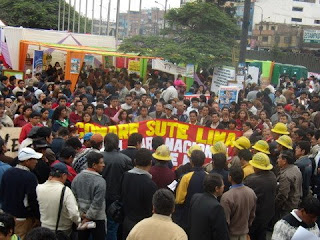
Self expression: a huge crowd watch theatre at the summit yesterday

Diana says she feels a mix of great satisfaction at the summit (as an opportunity for people to talk and be heard and learn from each other), but also a deep dissatisfaction at the lack of real dialogue between the governments in the official summit and the people:

“The position of the state in relation to all of this is interesting. You can see the fragmentation in which the state is acting in one sphere and the people are acting in another and you wonder where is the dialogue and space for conversation between the two. That’s what I feel is happening in Lima this week.

“I think the official summit responds to the needs of a specific economic model and so the proposals for solutions and any achievements they make are going to respond to that model – and by that I mean that they are not going to resolve the gap between rich and poor. They are working within the perspective of an economic model which continues to fragment society, making the poorest poorer and the richest richer.

Diana Torres


She sees the contrast between the lavish party to be laid on for delegates in Miraflores, one of the richest parts of Lima, and the ‘people’s party’ to be held miles away in another plaza, possibly with the presence of Evo Morles and Hugo Chavez, but no other leaders, as emblematic of the inequality and division in Peruvian society:

“In Miraflores, there will be a big party – who will be at that party?, and here there is going to be a big party – who will be at this party? It shows how divided we are: the state is on one side and civil society is on another.

“Alan Garcia can continue saying that we are in ‘a time of abundance’ and effectively we are, but abundance for who? I think that whatever is agreed at the summit will continue to sustain what is happening in Peru at the moment. I don’t think anything at all will change.


Criminalising protest

In Peru, civil society organisations are extremely concerned about the increasing repression of dissent. The government has introduced measures to try to increase control over NGOs and has openly attacked dissenting voices, calling them ‘terrorists’ and ‘traitors’ who are against development. He has also passed legislation which increases police impunity in cases of violence against protesters. Diana took part yesterday in some of the debates on this topic:

“It was interesting for me to understand the way protest is being criminalised here in Peru in relation to what is happening around the world – that protest and repression of protest is increasing at an alarming rate around the world”.

“One of the speakers said that protest and appears because it is so difficult to sustain the neoliberal model – it is almost a natural consequence of the unjust model – but then it becomes necessary to repress the protest so that it doesn’t have the impact that it should – changing the system. The repression is a symptom of an inability to sustain the system. I think that understanding that reflection might help us to find ways to act and respond.

“It was also interesting to hear that the same thing is going on in Europe – when supposedly we are developing countries and this shouldn’t be happening there…”

A learning opportunity

From her own perspective, having started relatively recently moved to Peru from her native Columbia to start work for Progressio, she says she found the summit a useful window on the reality in Peru:

“As a Development Worker, I think it has helped me to open up my vision – I have learnt things here that I hadn’t even learnt yet in the context of the organisation where I am working.

“It allows you to understand other aspects of the national reality which you cannot find out about through the media which don’t really represent these other worlds and other realities. It allows you to know what is happening for all the groups which are called ‘minorities’ but which are actually sustaining the country.

“You feel like communities are tired – that there are small efforts in the communities but that they aren’t enough. Here in this summit you can see that there are people who are really fighting and achieving important things - and that's encouraging."

--------------------------------------------------

Today the official summit gets underway properly and the alternative summit enters its last day. As Diana says, the two are worlds apart with the official summit talking about climate change in terms of carbon trading schemes and Garcia talking about the need to open Peru up to more investment, whilst the alternative summit talks of ecological debt and rejects all privatisation of natural resources.

I'm heading to the alternative summit now to hear the reading of the final declaration from the summit and the judgements of the People's Tribunal.

Thursday, 15 May 2008

An interesting article on the People's Tribunal which will report its judgements tomorrow

LATIN AMERICA: European Corporations on Trial - Milagros Salazar
LIMA - Twenty European corporations are being tried for human rights violations before an ethical tribunal at the Peoples? Summit, organised for the third time by the Bi-Regional Network "Enlazando Alternativas" (Linking Alternatives) in Lima. The organisers announced that they hope to take some of these cases to ordinary courts of justice in Peru.
http://www.ipsnews.net/news.asp?idnews=42372

Water and football

Presidents Summit begins

The LAC-EU summit started today. I’m watching the presidents arriving and the initial speeches on the TV as I type. According to the press, the Peruvian Government are saying that concrete agreements on climate change will be prioritised in the Lima Declaration to be signed by the parties, but that poverty reduction measures will probably appear as vaguer 'priorities' rather than set targets.

The negotiations have begun with the Peruvian government emphasising that it would like to negotiate a separate free trade agreement with the EU, rather than in combination the Andean Community of Nations (CAN). CAN is divided because whilst the right-wing governments of Peru and Colombia are keen, left leaning presidents in Ecuador and Bolivia are against signing. Europe wants to negotiate with the whole block. At the alternative summit of course there is strong resistance to free trade agreements.

This afternoon a delegation from the alternative summit took proposals gathered from the summit events up until now to present to representatives of each region at the official summit. As well as presenting some of the conclusions they also voiced disappointment at the ‘demonisation’ of the alternative summit as a violent ‘antisummit’ by the Peruvian government and the media and stressed that they sought dialogue and offered alternatives and proposals. They said it was wrong for such important discussion to take place in a closed meeting.

Alternative summit

The alternative summit today was even more packed than it has been up until now as today and tomorrow were declared impromptu public holidays to try to encourage people to leave the city. When we arrived an enormous queue of people were waiting to register for the summit and all day long, every workshop was bursting with people.

People peering in to packed forum from outside the tent

Water us a Human Right, An Ecological Good and a Public Service

I spent most of the day in a forum on water as a human right organised by a range of Peruvian organisations ( mostly trade union and campesino organizations) including FENTAP The National Peruvian Federation of Drinking Water Workers, CGTP, CCP, CONACAMI, CAN, CxD, Public Services International, CONAGUAYVIDA and FOS.

I was keen to hear the key concerns and issues for people as it is one of the key issues Progressio is researching for our international advocacy work. It was also interesting to contrast the concerns and demands with those made at the Fifth National Water Meeting in Ecuador.

It seemed to me that whilst the political context in Ecuador and Peru are very different, the concerns of the grassroots organisations are centred around the same issues and for both groups the issue of water is a vital issue – literally a life and death issue as people reiterated all day.

The difference is that whilst in Ecuador our partner organisation Cameren and the Water Resources Forum has been working on proposals many of which look likely to be included in the new constitution; in Peru, small scale farmers face a new set of legislative proposals being put forward by Alan Garcia’s government including a new water law, which they see as a huge threat (seeking to further privatise water, favour big companies, and turn water into merchandise over which they will lose control).

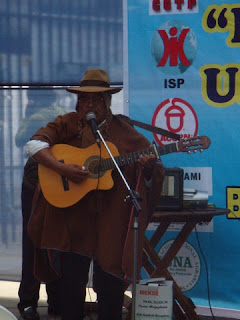
The issues which came up over and over again were: that water is a human right; that water should be managed by public institutions and that we should fight against privatisation and measures which seek to convert water into merchandise – with tradeable rights etc; that policies should favour the small scale farmers who are subsidising food production with their labour and not the agro-exportation industry which is environmentally and socially destructive; the need for policies which respect ancestral uses of water and cultural beliefs and management practices in relation to water; the need to resolve unfair water distribution in which transnational companies (extractive industries and agricultural) are awarded disproportionately large shares; the already frightening impacts of climate change on water supplies and fears for the future; the threat of agro-fuels; the impacts of deforestation; the inadequacy of social responsibility as a regulation model for industry.A song about injustice and water rights in Tacna, Peru

There was vehement consensus that water should not be included in any free trade negotiations at the LAC-EU summit As Carlos Franco from CONAGUAyVIDA said:
“Water should not enter into the LAC- EU negotiations. They are negotiating with our lives. They need to give campesinos back control over water”

Miguel Jugo from APRODEH , a human rights orgainsation talked about water as a fundamental human right for all - for urban populations and for agriculture. He emphasised the importance of the role of the state – “The state cannot pretend that water conflicts can be fairly resolved between the parties because the players are not equal – in a situation of transnational company versus communities, the company will win”. He argued that the government is failing in its responsibility to equitably distribute water resources: in Lima “some have no water at all whilst others have it in navigable quantities”.

Mario Pallacios from CONACAMI, the Confederation of Communities Affected by Mining talked about the mining industry’s huge demand for water, saying that every metric tonne of soil, metal and rock removed requires 3,000 litres of water to process. In his community 80% of the water is used by mining industry who extract 8,000 metric tones a day. In Yanacocha the figure is even higher with the gold mine there extracting 600,000 metric tonnes a day. He gave powerful examples of the devastating effect this is having on the environment.


Mario Pallacios


David Boys of PSI presented the global context and the failings of the privatisation strategy which has been promoted by the World Bank, IMF, Inter-american Development Bank motivated by: profit(“water is more valuable than oil”; the lack of public investment; market ideology; corruption in public companies; the incentives of cheap loans; international networks of academics; consultants and lobbyists.


David Boys


The forum's main points were summarised in a document which was added to the proposals presented to the official summit this afternoon.

---------------------------------------------------

Over the last few days, I had been thinking it was amazing to get over 3,000 people to attend an event like this, reflecting on how important the issues must be to so many people. But, after lunch I realised what could really draw a crowd. We were headed towards a climate change forum and were passed by a crowd of thousands heading in the other direction. Convinced I must be missing out on the most interesting talk of the summit, I asked where everyone was going: it turned out that the Bolivian President Evo Morales, had arrived for his football game against the Peruvian national team who played in the World Cup in Mexico in 1970. The stadium was soon packed out with hundreds clamouring outside the university gates being held back bypolice. As we left there were rumours that Chavez was shortly coming to join him.

Crowds and queues outside the Univeristy gates

Wednesday, 14 May 2008

Indigenous people uniting

“I want the presidents at the summit this week to realise that the people are here – so that it is not just a small group of the biggest capitalists having a discussion and then doing whatever they want. I want them to hear the people”.

So said Abraham Salazar, president of one of Progressio’s partner organisations in Ecuador, the Cotopaxi Indigenous and Campesino Movement (MICC - Movimiento Indígena y Campesino de Cotopaxi).


“This summit is a crucial opportunity for us, the indigenous peoples and nations to make the presidents realise that we are also meeting. We also have a summit and we are demanding our rights: we want them to respect our rights, our opinions and our territories. I hope that there can be a dialogue between the two summits and that they will hear our proposals”.

I spoke to him this afternoon just after he spoke on a panel alongside indigenous leaders from Columbia, Bolivia and Peru at a big meeting on Mining, Natural Resources and Indigenous Communities at the alternative summit. He emphasised how important it is for indigenous peoples to unite in their struggles:

“I think this summit here today is a very important space and a great opportunity to be able to exchange our experiences of our struggles for our land, our natural resources, our indigenous identity and rights.

“Today’s event has been an important forum for debate where we can see the perspectives of different indigenous peoples. I think this has helped to bring us closer together and see how much we have in common: we have the same problems. The way that we are treated by multinationals, how they cheat indigenous peoples, and the multinationals’ policies and practices are the same in all of our countries.

“The issues of mining, water, hydroelectricity and oil are very important issues for all of us. I believe that for a long time the oligarchic powers and the transnationals have just been taking from us – taking our resources, from our territory – in Columbia, Bolivia, Peru and Ecuador and in Chile and Argentina and other poor countries”.


Abraham is working with Fernando Ruiz, a Progressio Development Worker on a project to protect and manage paramos (high altitude scubland that looks like Scotland). Natural Resource management is an issue close to his heart:

“We, the indigenous peoples live in the paramos and in the mountains, in the highest places where there is water. That water is life and without it we will not be able to live. We need to conserve our ways of life – living in harmony between human beings and nature , together in pachamama [the mother earth]. We feel that capitalism and other processes are trying to extinguish all these cultures that we have: our indigenous plurinationality. It is like they are trying to force us all out.

“In Cotopaxi, Since when I first started on the governing council of MICC, I have been trying to work on and promote natural resource conservation. So together with Fernando, I have been working through workshops, and awareness raising in communities and people are starting to be more aware of the issues. Now that I’m a provincial leader I am working on the issues even more.

“As MICC we are putting more and more emphasis on the topic on natural resources and we are not going to drop that work – we are very involved in water, mining, the struggles against hydroelectric plants. Indigenous peoples are resisting . For example they want to give 50 year water concessions to big hydroelectric plants and mines and we are saying “No way, that is not going to happen when we can see that in other places, people are dying of thirst or hunger”.

“The government needs to start thinking about water by first of all prioritizing everybody having water. And looking at it from the perspective of Food Sovereignty – we are being turned into consumers – consumers who consume products imported from elsewhere. And what are we doing with our local produce, our native seeds?”

Abraham came to the summit with a small delegation from Ecuador to participate in the full week’s activities including an indigenous nations summit which took place on Monday. He believes the summit has helped to strengthen the movement at a regional level and strengthen MICC’s work in Cotopaxi:

“I think we will leave this summit at the end of the week with much more information and much stronger. In Ecuador I think we will be able to act in a much stronger way. I am seeing that Rafael Correa, the president in Ecuador has an internal position which is neoliberal and then an external one which is supposedly in favour of the poor but really it isn’t. He is cheating us and we cannot let that happen – behind what he is saying, he is pushing forward mining and hydroelectric power stations.

“We need to push for a total change in our countries so that they respect our culture, our forms of governance, our natural resources and our autonomy as indigenous peoples. I think that the summit has really helped us and now we need to keep in touch, keep strengthening our links and supporting each other, because the only way we are going to live well as is through our own struggles for indigenous rights”.

______________________________


Elsewhere at the summit, the activities continued with a packed day of workshops, fringe meetings and discussions. I went to a couple of interesting sessions on climate change, which is an important theme at the summit, interestingly, being addressed not just by environmental organisations but also by women’s organisations, human right groups and indigenous groups. The emphasis is on the issue as something which will have wide-ranging ramifications and which we all need to adapt to and tackle.

Outside the summit, preparations continued for the LAC-EU summit which starts on Friday. The chaos on the roads is impressive with extensive sections of road shut down and police ID checks on many streets; the international delegations are arriving; labour unions are threatening to strike during the summit to highlight their concerns; and Garcia, the President, created Peru’s first environment ministry and spoke on his proposal for a global fund to finance reforestation which could reforest ten million hectares could be reforested annually.

A few shots of the other activities at the summit: art for change, dancing and cultural displays, stalls, and the women's tent


Tuesday, 13 May 2008

El pueblo unido nunca sera vencido

The People's Summit started today. It is being held in a Lima University in the north of the city. Arriving at the campus we were greeted by a crazy colourful mix of lots of people and lots of causes…participants and organisers, setting up stalls, waving banners, registering, conducting interviews and flyering each other.


Once things got going, the morning was taken up with a long inauguration ceremony with lots of thank-yous and welcomes and a general scene setting. All the presenters were in agreement about the inequality and suffering caused by neoliberal polices and free trade agreements and gave impassioned speeches about the need for alternatives and the urgency to unite to fight for ‘other possible worlds’. They were also adamant that the summit was not an ‘anti-summit’ or counter summit as it has been labeled in the press, but a positive gathering to allow repressed voices to be heard and offer alternatives and solutions.


The speeches were followed by a ceremony by indigenous ceremony by people from different indigenous nations – including our partner Abrahan Salazar from MICC, the indigenous movement in Cotopaxi, Ecuador.

The audience was lively and passionate, frequently bursting out with chants and waving flags and banners: ‘ La Selva no se vende, la selva se defiende’ ( The jungle’s not for sale, the jungle should be defended’, ‘El pueblo unido nunca sera vencido’, (united we will never be defeated).

After the long complicated process of feeding over 2000 people, the real summit began with 10 simultaneous sessions taking place every 2 hours throughout the university with a bewildering range of topics including climate change, tools for women’s inclusion in social change, sexual and reproductive rights, migration and human rights, agro industries investment in free trade agreements, and workers rights. I went to the Permanent People’s Tribunal to hear Progressio partner organisation Accion Ecologica present the case against Repsol.

The Permanent Peoples’ Tribunal was apparently set up in 1979 as an international opinion tribunal, to examine and judge complaints of human rights violations submitted by the victims themselves or groups representing them. This session of the tribunal is focused on the actions of European multinationals in Latin America.

Today in the afternoon the panel of judges from 8 countries in LAC/ EU and two indigenous nationalities heard testimonies on the extractive industries including against the British mining company Majaz Monterrico Metals because of their activities in Peru. Members of communities presented their accusations of lack of transparency, illegal presence on community land without the populations consent, repression of protest and dissent (leading to two deaths and many injuries), defamation of critics and the creation of a climate of fear.

The government, they said, is complicit in backing the company “the government does not listen to us. We ask the judges to hear us and find the company guilty,” one witness said. The case is well known in Peru and our partner organisations Guarango and Peru Support group have both worked on it – Peru Support Group’s recent report gives more information on the issue.

There were then testimonies from Argentina, Bolivia and Ecuador against the Spanish multinational oil company Repsol. Alejandra Almeida from Acción Ecológica (an envirnonmental organization from Ecuador who we are working with on illegal logging) presented the environmental, cultural and social damage caused by the company in the Yasuní national park including water and soil pollution, biodiversity loss, soil erosion, displacement of communities, cultural destruction, dividing communities with conflicts, health impacts and the militarization of communities.

She said the company had turned the Huarani people who were once proud owners of a rich biodiverse forest into practically being beggars, dependent on food handouts, and concluded by asking the judges to find Repsol guilty of creating an enormous ecological and social debt.

The tribunal moved on to testimonies against the company Botnia and abuses and environmental damage caused by their plantation/paper factory in Uruguay. When the tribunal closed for the day, the evenings cultural activities began. I decided to face the maze of road diversions and road works and try to get home.

Monday, 12 May 2008

In the Lima Fog

I’m in Lima. The buzz and chaos in the city, caused by the official and alternative conference were immediately obvious on arriving last night.

The airport, hotels and roads are full. As my driver from the airport pointed out, half the roads are shut off for security reasons and the other half, were dug up in advance of the summit, but “in true Peruvian style, haven’t quite been repaired just yet”. There were frantic road works going on as we drove through the city at midnight.

Reading the papers this morning, the main topics of interest related to the summit are the road blocks and inconvenience of the security measures, the 6,000 police that have been transferred into the city and the public holiday that’s been declared during the official summit.

But its great also see that civil society groups are already achieving some of their aims by publicising some of their concerns. The summit doesn’t start till tomorrow, but the demands and themes of the alternative summit are in the press.

La Primera newspaper for example, carries an articles setting out the accusations against some of the companies which are to be judged in the People's Tribunal, including Majaz, a mining company which is accused of not respecting community’s right to consultation and operating illegally in various location. Guarango, a Progressio Partner organisation supported the community in Piura to publicise their problems and their community referendum in which an enormous majority voted against the mine last year in September. You can see some of the videos they produced on You Tube

Sunday, 11 May 2008

Summits

I’m in my flat packing to head to Lima tonight. I’ll be one of thousands from across Latin American, the Caribbean and Europe making my way to the Peruvian capital for a packed week of activities and meetings next week.

On May 16th and 17th leaders from nearly 60 Latin American and European countries will take part in the 5th Summit of Heads of State and Government of the European Union and Latin America and the Caribbean.

In advance of the meeting, from May 13th-16th, an alternative ‘People’s Summit’, the third ‘Enlazando Alternativos’ (Linking Alternatives) meeting will take place.

The Official Summit

The EU-LAC summits are the highest political meeting of the governments of the two regions. The EU-LAC strategic partnership began with the first summit in Rio in 1999 and was consolidated at further summits in Madrid (2002), Guadalajara (2004) and Vienna (2006).

The official summit in Lima has two topics on the agenda, both key themes for Progressio and our partner organisations :

(1) Poverty, inequality, inclusion - According to the EU’s official statement: “The Lima Summit will present the opportunity for a fruitful and open dialogue between both regions on the topic of social cohesion policies, including poverty alleviation measures to eliminate discrimination and the recognition of fundamental social rights. The objective is to share experiences, promote best practices and policies, and thereby contribute to more inclusive societies and more equal opportunities for all”.

(2) Sustainable development: climate change; environment; energy
The EU and LAC countries agreed at the 2006 Vienna Summit to launch a policy dialogue on environment. They intend to give special attention to cooperation in areas such as climate change, energy and other environment-related issues.

The EU is likely to try to advance trade negotiations with regional trade blocs such as Mercosur and the Andean Community.

The Alternative Summit

Enlazando Alternativas 3 is organised by a coalition of social movements and non-governmental organisations from Europe and LAC. The organisers are in opposition to the negotiations of free trade bilateral agreements and very critical of the EU’s trade strategy “Global Europe: Competing in the World” because it promotes greater social, labour and environmental deregulation.

They state that: “The peoples of Europe, Latin America and the Caribbean are being affected by so-called global capitalism, which is especially reflected in the proliferation of free trade agreements and the liberalisation of investments, which are tools for expanding the privileges of capital over the rights of the people. The Europe of capital and its governments thus foster a policy aimed at the reconquest of Latin America, just when the countries of the region are marking two centuries since the beginning of their struggles for independence.”

Through the alternative summit they aim to create an agenda of common plans and alternatives based on the proposals presented by social movements:

“In Lima in May 2008, we will not only create opportunities for critical analysis of relationships between the EU and ALC, including the association agreements, the behaviour of multinationals, militarism and the criminalisation of social movements on both continents, but there will also be a People’s Tribunal to judge the power system of the European transnationals, both in Latin America and the Caribbean and in the EU”.

The organisers expect more than 2,000 delegates from the different regions, to attend hundreds of workshops and meetings. The topics of the workshops and the perspectives represented are diverse with events linked to six broad themes: Neoliberalism in LAC and the EU; integration and trade agreements; extractive industries, climate change and its impact on natural resources and public services; campesinos and indigenous peoples, natural resources, agro-fuels, food sovereignty, and economic, social and cultural rights; labour trade union rights, housing and migration; and social movements and human rights.

Related activities have already started - yesterday a young people’s meeting took place, as well as an ‘Alternative Media and Radios Forum’, and the ‘Sao Paulo Forum’ of various leftwing parties from LAC. Tomorrow the International Forum of Indigenous Agendas and Decolonization from Power and Knowledge begins, as well as the 2nd National Summit of Indigenous Peoples and Communities of Peru. On May 14th, there’s a preparatory meeting towards the 1st Continental Summit of Indigenous Women, to be held next year. And as part of the summit there will be a tribunal to try transnational companies.

Progressio partner organisations will be taking part in a range of events: for example at the airport tonight I’m expecting to meet Abrahan Salazar one of the leaders of MICC, the indigenous movement of Cotopaxi in Ecuador who is travelling to take part, Accion Ecologica, another Ecuadorian partner is also participating and will be running a session on the privatisation of public services, public goods and local resistances to global threats, CEPES a Peruvian partner is part of a workshop on Democratising Communications and a colleague from the network of Canastas Solidarias (food coops) in Ecuador who is working with our partner CEA on a campaign for healthy, secure, sovereign food will be presenting on their experiences.

At the ‘Permanent People’s Tribunal’ over 20 European corporations will be ‘tried’ over human rights and labour rights violations and environmental and social damage in Latin America. The corporations to be tried include: Majaz-Monterrico Metals and Vale do Rio Doce from the mining sector; as well as Roche and Boehringer from the pharmaceutical industry; Shell and Repsol YPF from the oil sector; Botnia and ENCE from the forestry-pulp industry; Syngenta in the agribusiness sector; Skanska and Thyssen Krupp in the infrastructure sector; ETI-Telecom in the telecom sector; Unión Fenosa and Suez in the electricity sector; Aguas de Barcelona and Proactiva (Veolia-FCC) in the water sector, Unilever, Camposol, Cermaq Mainstream and Marine Harvest in the agrifood sector, Bayer in the agrochemical sector, and BBVA, HSBC and Santander in the banking sector.

Demands and proposals from Linking Alternatives 3, the Peoples’ Permanent Tribunal and the other events will be delivered to the presidents and head of state attending the official summit. The closing event is planned for the 16th. The Presidents of Bolivia and Ecuador, Evo Morales and Rafael Correa are expected to attend the closing event.

I’m going to try and write something each day on what’s happening at the summits so watch this space!